
Data model controls work machines
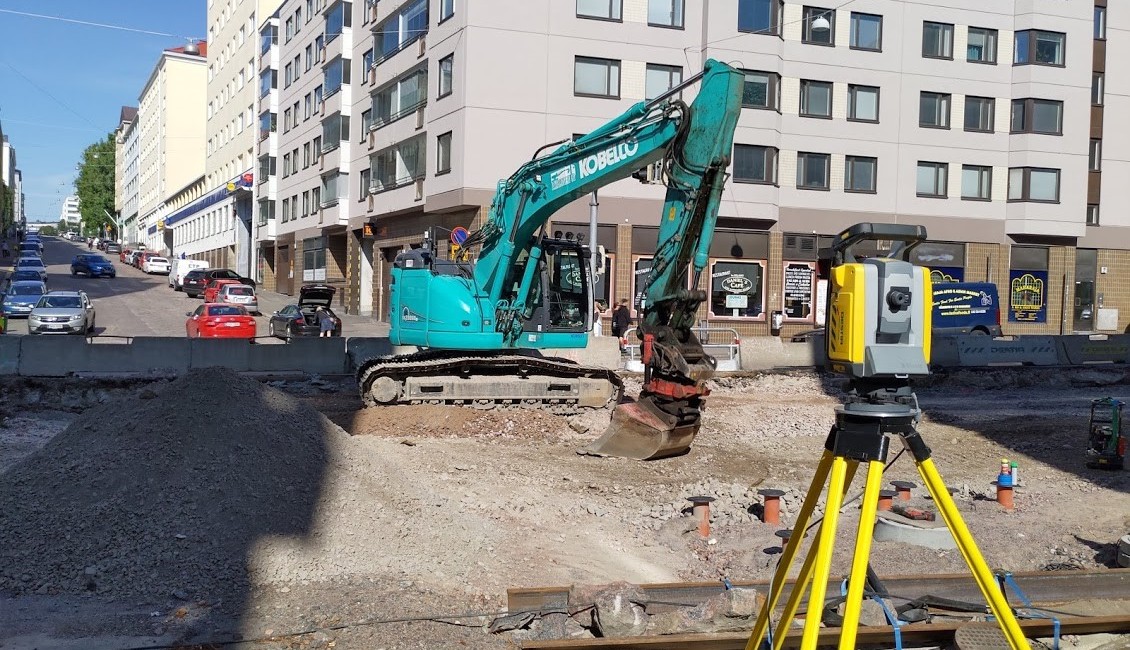
A remotely controlled road construction site where automated machines are working instead of people. Such a vision of the future sounded utopian ten years ago, but it is getting closer day by day. Digitalisation has progressed with leaps and bounds in recent years in infrastructure construction, and Destia has been at the forefront of it since the beginning.
Data models and work machine automation have become commonplace for the company in almost all major infrastructure and road projects. In the coming years, they will be utilised even more extensively and gradually also in municipal and city infrastructure renovation. According to Mika Jaakkola, the Development Manager of Destia’s Road Services, the reasons for the increase in popularity are quite clear.
“Building information model (BIM) based implementation improves quality, increases efficiency and makes it possible to monitor a project’s volume and completion level in real time. Information also flows smoothly between the different parties of a project when everyone is using the same cloud service platform. The result is faster completion times, cost savings and a smaller carbon footprint for projects,” Jaakkola lists.
Boost from cloud service
At Destia, model-based infrastructure construction and work machine automation have been developed since the beginning of the millennium. At that time, the technology and applications were still modest compared to the current ones, but according to Jaakkola, they already gave a clear indication of the benefits that digitalisation could achieve.
A significant leap forward was made in the late 2000s, when earthmoving and excavating machines began to make extensive use of GNSS positioning and a separate display was introduced in the cabs from which the driver could compare the progress of his own work with the data model.
“It was discovered quite quickly that with such tools, the productivity and quality of construction sites will also improve,” says Jaakkola. Destia was the first in Finland to fully implement the operating methods and know-how of the new technology.
The next major leap forward was taken a scant decade ago with the introduction of a real data model-based production through the Infrakit cloud service. The work machines were monitored in real time, the data was easy to share thanks to wireless technology, and it could also be used in work supervision on mobile devices.
BIM production is precise custom work
Destia is now at a point where road projects are starting to be digitalised from design to construction. Projects are also supervised, managed and compared to the original 3D model based on real-time data collected daily from construction sites. The data to support management and design can be obtained from, for example, work machines, 360-degree site photographs, and aerial photographs taken by drones.
“We utilise model-based production in about 30-50 projects a year. 300-400 work machines, trucks and other equipment are connected to our data platform. We use this operating model in all major projects, and our subcontractors must also be able to use it,” says Jaakkola.
In practice, the progress at the construction site and the movements of the work machines can be monitored in real time not only in project management but also in planning and at the customer end. At the construction site, on the other hand, bespoke work to the centimetre is carried out according to the data model, and if non-conformities to the 3D model of the site are detected, the information is immediately communicated to all parties.
“If necessary, plans can be changed quickly,” Jaakkola adds.
Great benefits in urban infrastructure repairs
In addition to road construction, model-based production has also shown its strength in other infrastructure and civil engineering works, such as model-based compaction, subgrade strengthening and rock construction.
“The next big area will be urban development, where basic infrastructure is aging and is often poorly documented. With model-based production, the data can be updated and recovered for the next generations of builders,” says Jaakkola.
And when will we be in a situation where the work machines do their work independently according to a data model and supervised by machine vision and drone cameras?
“It will come in time but requires a much more automated fleet than what is available now. Digitalisation and work machine automation are, however, already visible on construction sites. If we compare the situation to, for example, ten years ago, there are fewer than half of the people needed to work on the site management and especially measurement tasks, and they can use their time more efficiently with less time spent on routines.”