
The synchronous condenser enables the growth of wind power production
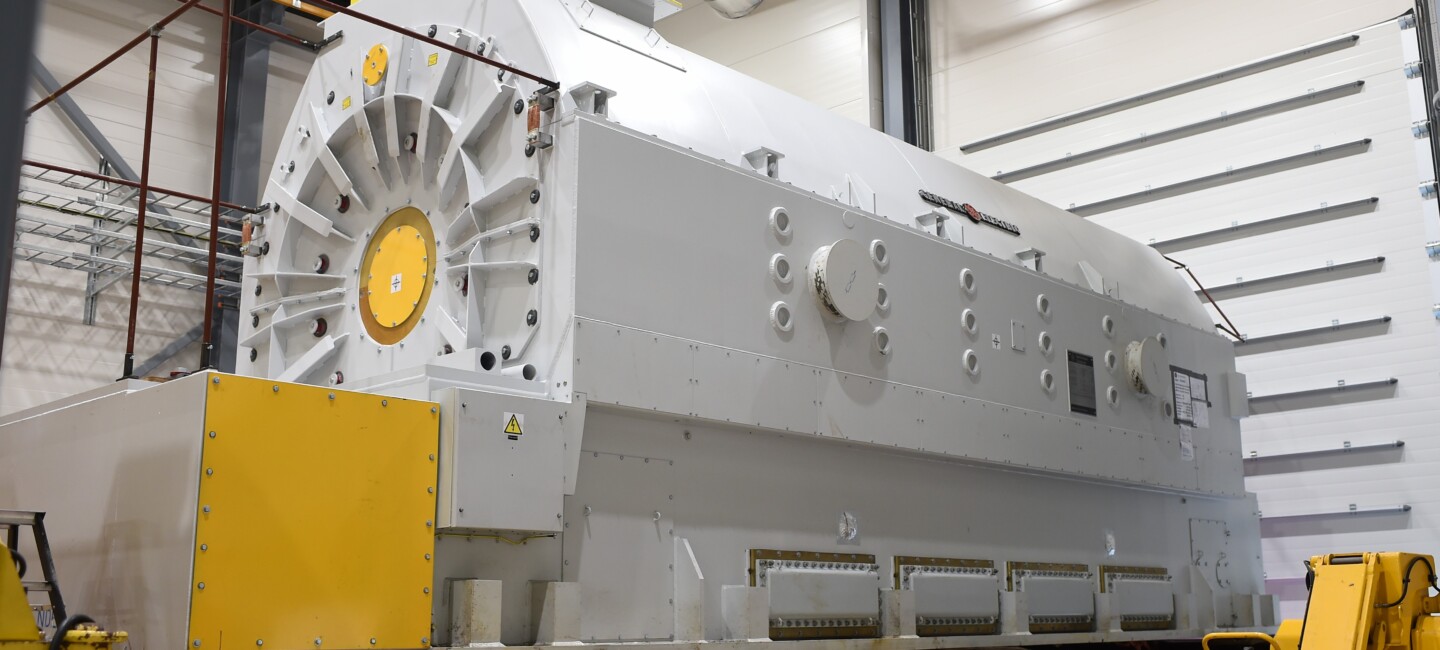
Here it is: Finland’s first synchronous condenser. From the outside, it looks like an ordinary factory hall, but inside it houses a massive system that adds a new dimension to Finland’s energy production by stabilizing the voltage fluctuations in the electricity grid caused especially by renewable energy.
The synchronous condenser is a flywheel that operates without a power machine, producing reactive power for the regional grid and balancing voltage fluctuations as it spins at 3,000 revolutions per minute. The device is a response to the growing wind power production, particularly on the Finland’s west coast, and it enables an increase in renewable energy production.
“The large regional amount of wind power poses a challenge for the electricity system, as wind turbines connect to the grid through inverters. Even if the wind blows continuously, wind turbines do not have the same reactive power or inertia that maintains the electricity grid and stabilizes frequency changes, as seen in hydro or nuclear power plants,” says Ilkka Koskela, Director at Destia’s Energy Networks division.

The flywheel stabilizes the grid
Destia has built the synchronous condenser in Kalajoki, next to one of Finland’s largest substations, Jylkkä. The substation is expected to have significantly more wind power production than the 1,600 megawatts generated by the Olkiluoto nuclear power plant’s third reactor.
“The decision to build the synchronous condenser in Jylkkä was made due to the significant wind power production in the area, as the device is needed to support local grid management. The operation of the regional grid, of course, also affects the national management of the electricity grid on a broader scale,” explains Juha Pikkupeura, project manager at Fingrid.
Destia has been responsible for the implementation of the synchronous condenser from start to finish, including design, foundation and earthworks, installation, as well as ongoing testing and commissioning. During the test operation that began in early June 2025, the aim was to ensure that the flywheel was operating and spinning as planned in the future.
“The device will gradually start using automatic functions. During the test operation, we ensured that the automation functions worked correctly, the device could be connected to the grid and started, and everything was running as it should,” says Koskela.
A new type of project has provided lessons for the future
The project, implemented for the first time in Finland, has taught its creators as the work has progressed, and this completely new type of project has required not only diverse expertise but also a lot of familiarization and learning.
“When you are the first to do something, you have to clear a path through the unknown and figure out things from scratch. Many aspects of the project were familiar to us from the substation and building construction projects, but on the other hand, many factors were completely unique in this case,” Koskela notes.
When you are the first to do something, you have to clear a path through the unknown and figure out things from scratch.
Experience is not yet found in neighboring countries, but it is available a bit further south in Europe. Destia’s project team was able to draw on experience from Kraftanlagen, which is part of the same Bouygues group, and has been working on a similar project in Germany about a year ahead of the Kalajoki project.
“Especially in the early stages of the project, we gained valuable practical knowledge and experience when we were able to exchange ideas and discuss a similar project. The collaboration gave us a clearer view of the upcoming work phases and helped us concretely understand what lies ahead. Now, at the final stages of the project, our knowledge base has grown quite a bit, and the path for future projects is already prepared,” says Koskela.

The need for stabilizing the electricity grid continues
It is likely that there will be more to come, and the cleared path will be utilized in the coming years. Significant growth is forecasted for Finland’s wind power capacity, so there will be a continued need and demand for stabilizing the electricity grid.
“With a high probability, the production of solar and wind power will also grow in the future, and integrating new production into the electricity grid requires continuous development. The needs and planning of the grid will determine what type of compensation will be needed in the future – but some form of compensation will most likely be needed in any case,” Pikkupeura explains.